

Features
A coach who knows the situation you're in.
Daz reads the same scenario you're in, sees every decision you've made so far, and knows the skills your role is measured on. Get stuck halfway through and Daz helps you work it out, with questions and hints about your actual project.
Start practicing free →The problem
Generic AI chat gives generic advice. Ask it how to handle a sponsor who's losing patience and you'll get a tidy list that fits every project and helps on none of them. Useful coaching starts with knowing what's actually going on.
How it works
Feedback on every decision
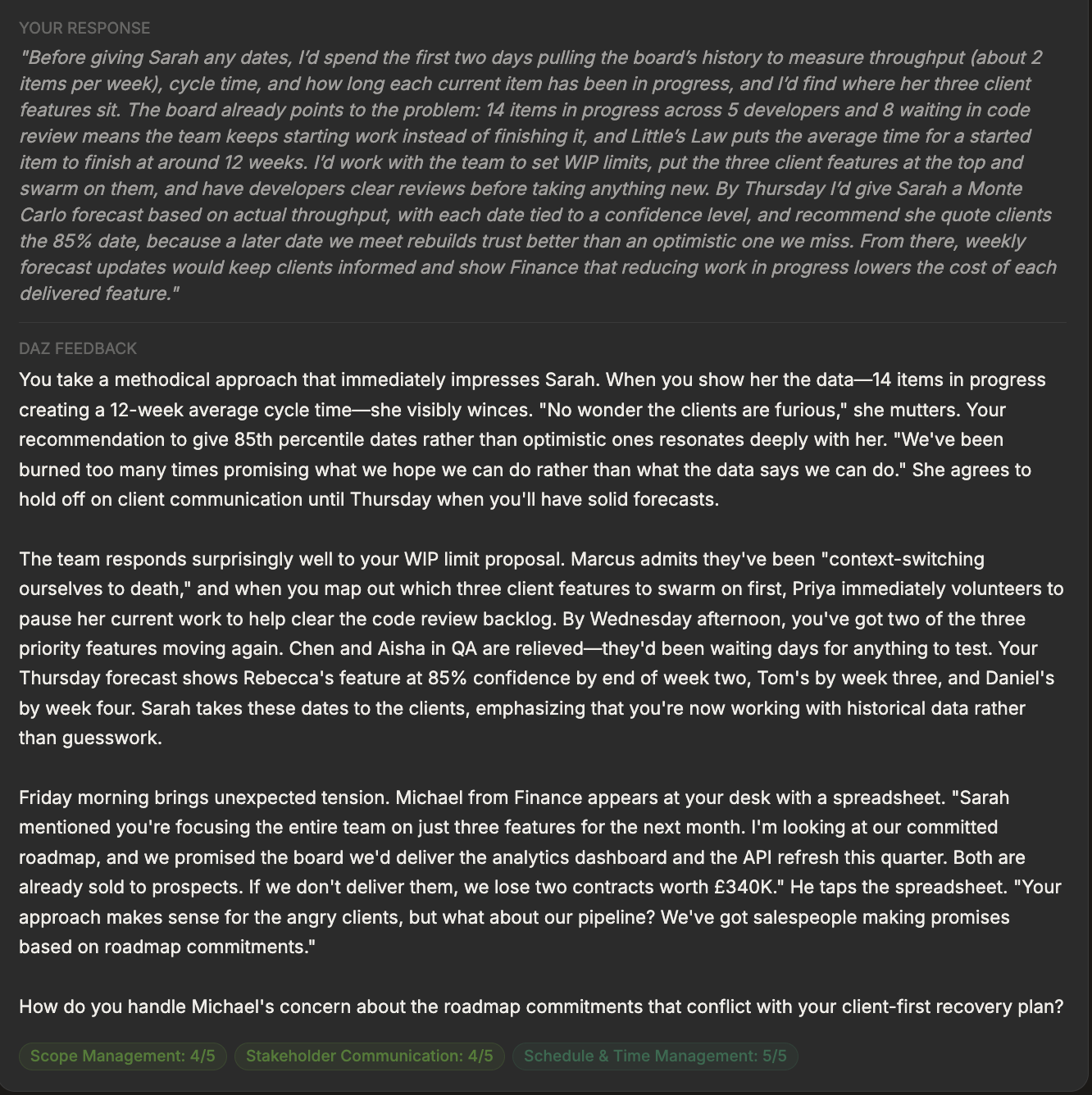
After each decision, Daz scores it from 1 to 5 on the specific skills it tested and explains why. You see how your approach played out and what it set in motion, so the score comes with something you can use next time.
Ask in the middle of a scenario
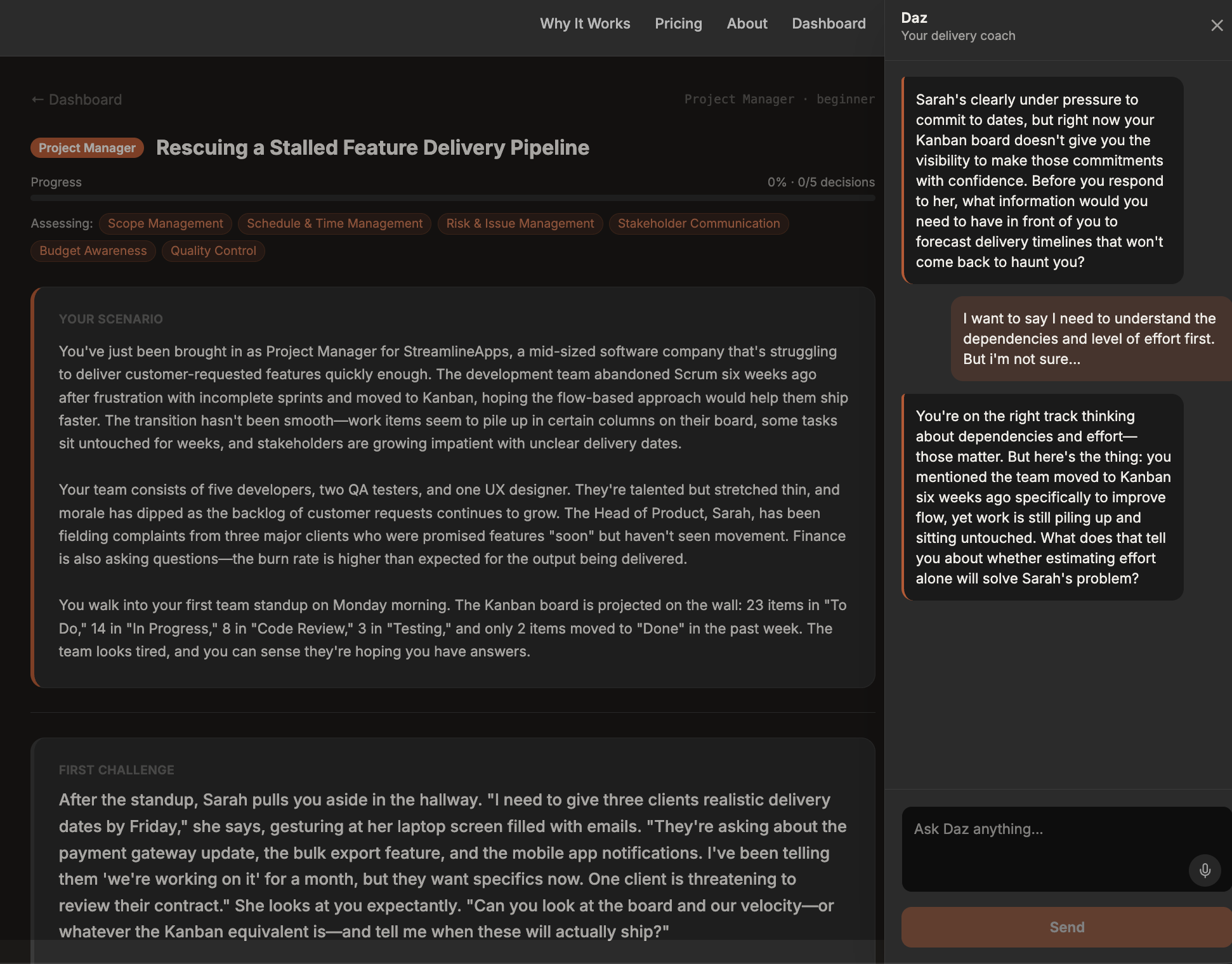
Stuck on a call? Open the coach and ask. Daz has the scenario's setup, the challenge in front of you, every decision you've made so far and how each one scored. It keeps track of your recent messages too, so you can push back and go a few rounds. Daz won't hand you the answer. It asks the question that gets you there, and gives you a hint if you're really stuck.
Advice that fits your role
A Scrum Master and a program manager facing the same blocked dependency should handle it differently. Daz coaches against the six skills your role is measured on, so the advice matches the job you do or the one you're going for.
Who it's for
Anyone who's wished they could talk a decision through with someone experienced before committing to it. Daz is the experienced colleague who makes you say your reasoning out loud before you commit, and tells you plainly when a call didn't land.
The science behind it
One-on-one coaching is one of the most effective ways people learn. A review of the tutoring research found that human tutors raised test scores by about 0.8 standard deviations, and well-designed computer tutors came close behind at 0.76 (VanLehn, 2011). Daz is built to bring that kind of coaching to delivery work.
How a coach helps matters as much as whether it helps. Asking questions that make you explain your own thinking is the core of Socratic coaching, and it holds up in the research: people who are prompted to explain their reasoning understand the material more deeply than people who just reread it (Chi et al., 1994). The flip side shows up with AI. A field experiment in high school math classrooms found that students who used a standard chatbot that handed over answers did worse on their own once it was taken away. Students who used an AI tutor designed to give hints instead avoided that drop (Bastani et al., 2025). That's why Daz pushes you to reason through a call instead of making it for you.
The newest evidence is encouraging. In a 2025 randomized trial with 194 Harvard physics students, those who learned from an AI tutor built on proven teaching practices learned significantly more, in less time, than students in an active-learning class led by experienced instructors, and they reported feeling more engaged (Kestin et al., 2025). The difference was in the design. The tutor was built to teach, not just to be helpful.
Sources
- Bastani, H., Bastani, O., Sungu, A., Ge, H., Kabakcı, Ö., & Mariman, R. (2025). Generative AI without guardrails can harm learning: Evidence from high school mathematics. Proceedings of the National Academy of Sciences, 122(26), e2422633122.
- Chi, M. T. H., de Leeuw, N., Chiu, M.-H., & LaVancher, C. (1994). Eliciting self-explanations improves understanding. Cognitive Science, 18(3), 439-477.
- Kestin, G., Miller, K., Klales, A., Milbourne, T., & Ponti, G. (2025). AI tutoring outperforms in-class active learning: An RCT introducing a novel research-based design in an authentic educational setting. Scientific Reports, 15, 17458.
- VanLehn, K. (2011). The relative effectiveness of human tutoring, intelligent tutoring systems, and other tutoring systems. Educational Psychologist, 46(4), 197-221.
Recent updates
Voice input for decisions and coaching
Speak your answer instead of typing it, on desktop and mobile browsers.
Daz responds in real time
Coaching, chat replies, and scenario openings now stream in as Daz writes them.
Your role now shapes the whole experience
Persona-driven scenarios, a skill dashboard, a context-aware coach, and Google and LinkedIn sign-in.
DazIQ opens to alpha testers
The first version of DazIQ: AI-generated delivery scenarios, scored decisions, and a coach in your corner.